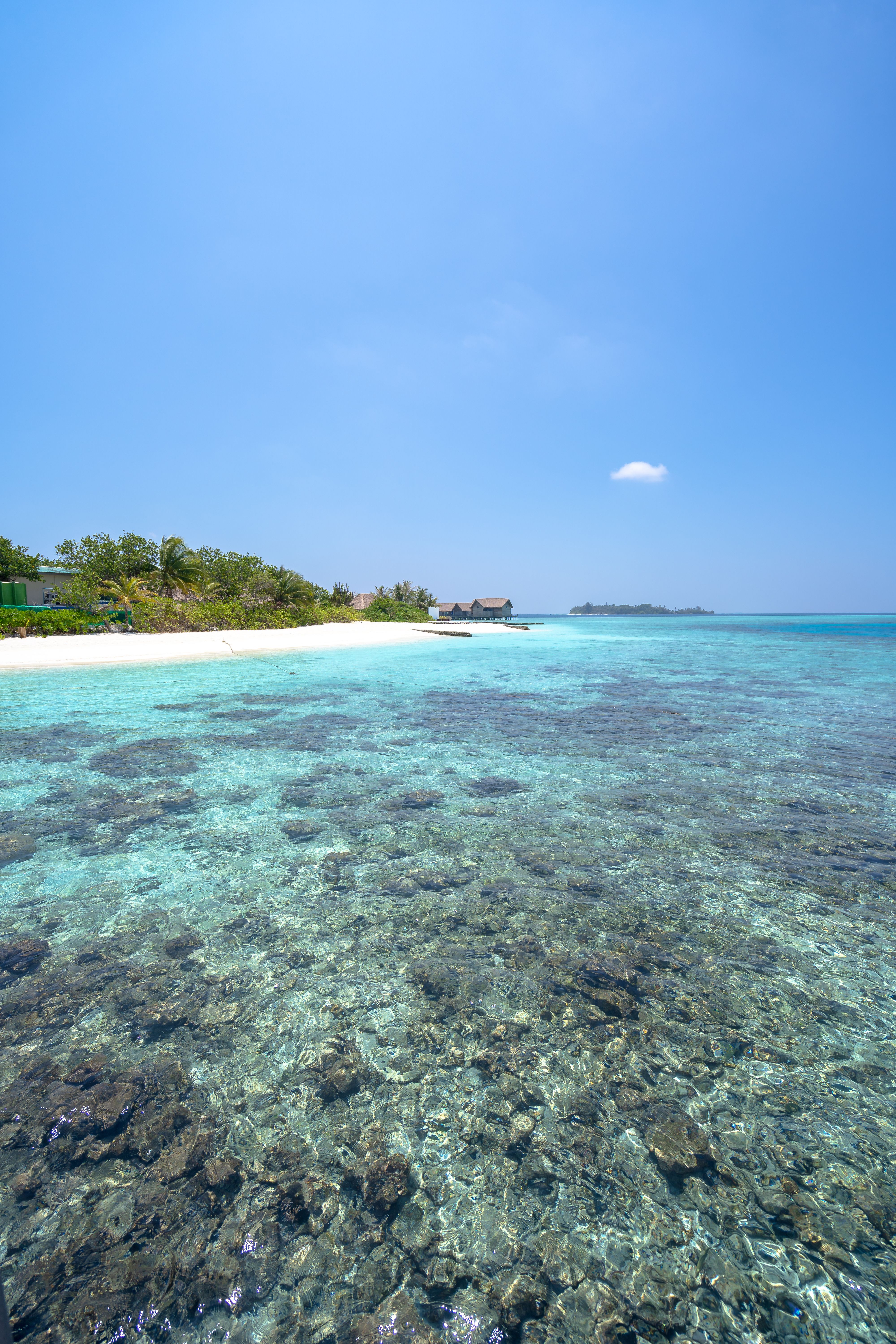
A lot of Maldives content defaults to couples and honeymooners, which can make the destination feel like an odd fit for a family trip at first glance. In practice, the opposite is often true: calm, shallow lagoons, an all-inclusive meal structure that removes most day-to-day decision friction, and resorts genuinely set up for children make the Maldives a strong family destination once you know which decisions matter differently with kids in the group.
This guide covers exactly those decisions — villa type, kids clubs, child pricing, which atoll to choose, and a realistic family budget — building on the fundamentals already covered in our complete package guide and trip cost breakdown.
On this page
- Why the Maldives works for families
- Beach villa vs overwater villa with kids
- Travelling with teenagers vs younger children
- Multi-generational family trips
- Kids clubs: what to actually check
- Child pricing and meal-plan discounts
- Choosing an atoll with young children
- All-inclusive with kids, revisited
- A realistic family budget
- Packing and health considerations
- A sample family itinerary
- Mistakes families make booking this trip
- FAQ
Why the Maldives works for families
Three structural features of a Maldives resort holiday line up unusually well with what families actually need, more so than many alternative beach destinations.
- Self-contained islands remove a layer of logistics that exists at almost any other destination — there's no driving to a restaurant, no navigating unfamiliar public transport with tired children, since everything the family needs is a short walk from the villa, which matters more with young children than almost any other single factor.
- All-inclusive meal plans, covered in detail in our dedicated guide, are particularly well suited to families specifically because they remove the per-meal price anxiety that can otherwise turn every mealtime into a small negotiation, freeing parents to focus on the meal itself rather than the bill.
- Calm, shallow lagoons at most resorts give young children safe water access without the wave conditions or currents that can make ordinary beach destinations stressful to supervise, and the warm year-round water temperature means there's no cold-water adjustment period the way there might be at a temperate-climate beach destination.
None of this means every resort suits every family equally — the sections below cover the specific choices that genuinely matter once you've decided the Maldives itself is the right destination.
Beach villa vs overwater villa with kids
This is the single most important villa decision for a family, and it differs from the honeymoon-focused trade-off covered in our couples guide in one critical way: safety, not just privacy and atmosphere.
An overwater villa typically offers direct access to deep lagoon water from a deck or ladder, often with only a low rail or no barrier at all between the living space and open water — a genuine drowning risk for young children that isn't really a consideration for an adult couple. Most resorts don't actively prohibit families from booking overwater villas, but many family travel specialists and a number of resorts themselves recommend a beach or garden villa for families with children under roughly 6–8, specifically because of this water-access risk.
A beach villa, or a dedicated family villa where resorts offer the category, generally gives a child a buffer of dry sand and shallow water before reaching anything deep enough to be a real risk, and is almost always the more practical choice for active supervision. Some resorts offer connecting or adjoining beach villas specifically designed for families needing two rooms, which is worth asking about directly if your family is too large for a single villa.
Worth knowing
If an overwater stay still appeals — for an older-children family, for instance — ask the resort directly about villa-specific safety features such as full-height glass barriers or lockable deck gates, since these vary considerably between resorts and even between villa categories at the same resort.
Travelling with teenagers vs younger children
Most of the planning advice above is weighted toward younger children, since that's where the biggest safety and logistics decisions sit — but a family with teenagers faces a meaningfully different set of considerations worth a direct mention.
Teenagers are generally well past the overwater-villa safety concern that applies to young children, and often genuinely enjoy the novelty of a seaplane transfer and a more remote, luxury-leaning resort that wouldn't suit a toddler's schedule at all. Many kids clubs cap out well below teenage years, so older children are more often treated as young adults for activity purposes — worth checking whether a resort offers a dedicated teen programme (diving certification courses, watersports, a teen-only lounge) rather than assuming the standard kids club extends to them. Wi-Fi quality, sometimes deliberately limited at remote luxury resorts as part of a "digital detox" positioning (covered in our complete package guide), is worth checking specifically if connectivity matters to your teenager's enjoyment of the trip, since this varies considerably by resort.
Multi-generational family trips
A trip spanning grandparents, parents and children is common enough, particularly for milestone celebrations, to deserve its own brief section. The core challenge is usually villa configuration: most standard villas are built around two adults plus a child or two, not three generations comfortably sharing space, so multi-generational families typically need either two adjoining villas or a resort's specific family/group villa category, where one exists.
It's worth contacting a shortlisted resort directly about multi-generational group needs rather than relying solely on the standard booking engine, since several properties maintain some flexibility around connecting rooms or grouped villas that isn't always visible through a standard online search. Mobility is also worth considering specifically for older grandparents — resort islands can involve a fair amount of walking between villa, restaurants and beach, and it's reasonable to ask a resort directly about path surfaces, golf-buggy transfers around the island, and accessibility features before booking if this is a concern for anyone in the group.
Kids clubs: what to actually check
Many resorts maintain a kids club, but the quality, age range, and inclusion terms vary enough that "has a kids club" alone isn't a useful enough filter on its own.
- Age range — most clubs cover a band somewhere between 3 and 12, but the exact cutoffs vary; if you have a toddler under 3, specifically confirm whether the resort offers any supervised option at all, since many clubs don't accept children that young and you may need to plan your own days around full-time supervision instead.
- Inclusion in your rate — some resorts bundle kids club access into the room rate or an all-inclusive premium plan, while others charge per session or per day; this is worth confirming before you assume it's free, since an unexpected daily charge across a multi-night stay can add up to a meaningful sum.
- Staff-to-child ratio and qualifications — better-resourced clubs are usually transparent about this; it's a reasonable, non-intrusive question to ask directly rather than assuming a uniform standard across all resorts, particularly if your child has any specific needs worth flagging in advance.
- Programme structure — some clubs run structured, supervised activity blocks; others are closer to an open-access play area with looser supervision. Either can work depending on your child and your own plans for the day, but it's worth knowing which model a specific resort follows before you build a schedule around it.
Child pricing and meal-plan discounts
This is one of the more meaningful cost levers for a family trip, and it's worth understanding clearly rather than assuming a flat per-person multiplication of the adult rate.
| Age band | Typical room policy | Typical meal-plan policy |
|---|---|---|
| Under 2 | Usually free, sharing existing bedding | Usually free or nominal charge |
| 2–6 | Often free or heavily discounted sharing with two adults | Often free or discounted on the all-inclusive add-on |
| 6–12 | Discounted rate sharing, varies by resort | Discounted meal-plan add-on, varies by resort |
| 12+ | Usually treated as an adult for room and meal pricing | Usually treated as an adult for room and meal pricing |
These bands vary meaningfully between resorts, so treat this table as a general pattern to verify against your specific shortlist rather than a fixed rule. The gap between a generous and a stingy child policy can be a genuinely large share of a family's total budget, particularly for a family with two or more children in the discounted age bands, making this worth checking early in your resort comparison rather than as an afterthought once you've already chosen based on the adult rate alone.
Choosing an atoll with young children
The atoll-choice logic from our complete package guide applies with extra weight when young children are involved, mainly through the transfer-time lens.
A speedboat-zone resort in North or South Malé Atoll, reachable in well under an hour, is generally the easier choice with toddlers or young children, since it minimises the most logistically taxing part of the journey — keeping a young child settled through a transfer — and reduces the chance of a tired, overstimulated arrival. A seaplane transfer to an outer atoll, while often a wonderful experience for slightly older children who'll enjoy the novelty of it, adds noise, a stricter luggage allowance, and a less flexible schedule that can be harder to manage with an unpredictable toddler nap schedule.
This isn't a hard rule — many families do very happily choose outer-atoll resorts, particularly with school-age children rather than toddlers — but it's worth weighing transfer type as a genuine parenting-logistics decision rather than purely a luxury-versus-budget one, as it might be for a couple without children. It's also worth checking a seaplane operator's own policy on infants specifically, since some seaplane services apply minimum-age restrictions for safety reasons that simply don't come up when researching the destination in general terms — confirming this before falling in love with a specific remote resort avoids a disappointing discovery late in the booking process.
All-inclusive with kids, revisited
Our dedicated all-inclusive guide covers this in general terms, but it's worth restating the family-specific case directly: for almost any family, all-inclusive is close to a default-yes decision, considerably more clearly than it is for a couple weighing their own drinking and eating habits.
Multiple daily meals for several people, often with different preferences and patience levels, without per-meal price anxiety, is exactly the scenario all-inclusive is built for. Combined with the child meal-plan discounts covered above, the all-inclusive upgrade for a family frequently pays for itself well within a typical 4–5 night stay, especially compared to the alternative of paying à la carte prices for every meal at a destination with no cheaper off-resort dining option.
A realistic family budget
Building on the worked-budget approach from our cost breakdown guide, here's an itemised mid-tier example for a family of four (two adults, two children aged 5 and 9), 4 nights, all-inclusive.
| Item | Cost (family of 4) |
|---|---|
| Flights, 4 people (mid-strength Indian gateway) | ₹1,20,000 |
| 4 nights, 1 family/connecting beach villa, all-inclusive (with child discounts applied) | ₹2,60,000 |
| Speedboat transfer, 4 people | Included in rate |
| Kids club (where charged separately) | ₹8,000 |
| One family excursion | ₹18,000 |
| Incidentals, spa for parents, extras | ₹24,000 |
| Approximate total | ₹4,30,000 |
That works out to roughly ₹1,07,500 per person — noticeably below the same mid-tier total for two unrelated couples booking separately, almost entirely thanks to child pricing on both the room and the meal plan. This is a useful sanity check whenever a family quote looks unexpectedly high: confirm the child rates have actually been applied correctly before assuming the Maldives is simply unaffordable for a family trip. A budget-tier family trip on a local-island guesthouse, following the same child-discount logic, can bring this down further still, while a luxury-tier family trip with two overwater villas — as modelled in our cost breakdown guide — sits considerably higher, mainly due to needing two premium villas rather than one family-configured room.
Packing and health considerations
- Sun protection — reef-safe sunscreen, as covered in our complete package guide, matters even more for children's more sensitive skin; pack a sun shirt or swim rash guard as a low-effort extra layer of protection for long beach days, since reapplying sunscreen on a wriggling toddler every two hours is rarely realistic in practice.
- Basic medication — a small first-aid kit including child-appropriate fever and motion-sickness medication is worth packing, given how limited general shopping is once you're on a private resort island, and especially useful if your transfer involves a speedboat or seaplane that might trigger motion sickness in a child who hasn't experienced one before.
- Swim aids — most resorts can provide or rent basic flotation aids, but bringing a familiar one from home can help an anxious young swimmer settle into unfamiliar water more comfortably, particularly in the first day or two before the lagoon starts to feel like a normal part of the daily routine.
- Documentation — children need their own passport for Maldives travel; if a child is travelling with only one parent, it's worth checking current requirements around consent documentation well ahead of departure, since this can vary and is worth confirming directly with your airline and the Maldives immigration authority rather than assuming a single global standard applies.
A sample family itinerary
- Day 1 — Arrival. Keep this entirely unscheduled; a transfer and check-in is enough disruption to a child's routine for one day.
- Day 2 — Settle in. Kids club orientation if your children are old enough, gentle beach and pool time, an early dinner.
- Day 3 — Family excursion. A gentle snorkelling introduction or a sandbank picnic, scheduled for a time of day that works around nap schedules if relevant.
- Day 4 — A split day. Older children at kids club for part of the day while parents get a couple of hours to themselves, recombining for the afternoon.
- Day 5 — Departure. A relaxed final morning, transfer timed with enough buffer that a delay doesn't turn into a stressful sprint with tired children in tow.
Mistakes families make booking this trip
- Booking an overwater villa without checking child-safety features, as covered above — worth a direct question to the resort rather than an assumption either way, since the answer genuinely varies and the consequence of guessing wrong is serious rather than merely inconvenient.
- Assuming all kids clubs are interchangeable, when age ranges, inclusion, and programme quality vary meaningfully resort to resort, sometimes enough to change which resort is actually the better fit for your specific children.
- Choosing a remote, seaplane-access resort with very young children without weighing the added transfer complexity against the benefit, which often matters more to parents' Instagram feed than to a toddler who won't remember the seaplane at all by the time they're old enough to talk about the trip.
- Not confirming child rates before booking, leading to a final bill considerably higher than expected once add-ons are applied at full adult price by default rather than the discounted family rate you assumed was automatic.
- Over-scheduling the trip with excursions on every day, which tends to exhaust children (and parents) faster than the unstructured alternative recommended throughout our honeymoon and complete package guides alike, and which leaves little room to simply respond to how the children are actually feeling on a given day.
Frequently asked questions
Is the Maldives a good destination for young children?
Yes, provided you choose a family-oriented resort with shallow, calm lagoon access and a kids club. The main planning considerations are choosing a speedboat-zone resort to minimise transfer time with young children, and confirming the resort's age policies for kids clubs and pools in advance.
Do children stay free at Maldives resorts?
Many resorts offer free or heavily discounted stays for children under a set age, commonly 2–6 for free and 6–12 at a reduced rate, when sharing a room with two paying adults. Policies vary significantly by resort, so it's worth confirming the exact age cutoffs and inclusions before booking.
What is the best villa type for a family with kids?
A beach villa or family villa with direct, shallow lagoon access is generally safer and more practical for families than an overwater villa, which carries a real drowning risk for young children given direct deep-water access from the room itself.
Related reading
For the full price-tier breakdown this page's budget table is built on, see our trip cost breakdown, and for meal-plan specifics, our all-inclusive guide.
Some links above are affiliate links. If you book through them, we may earn a small commission at no extra cost to you.