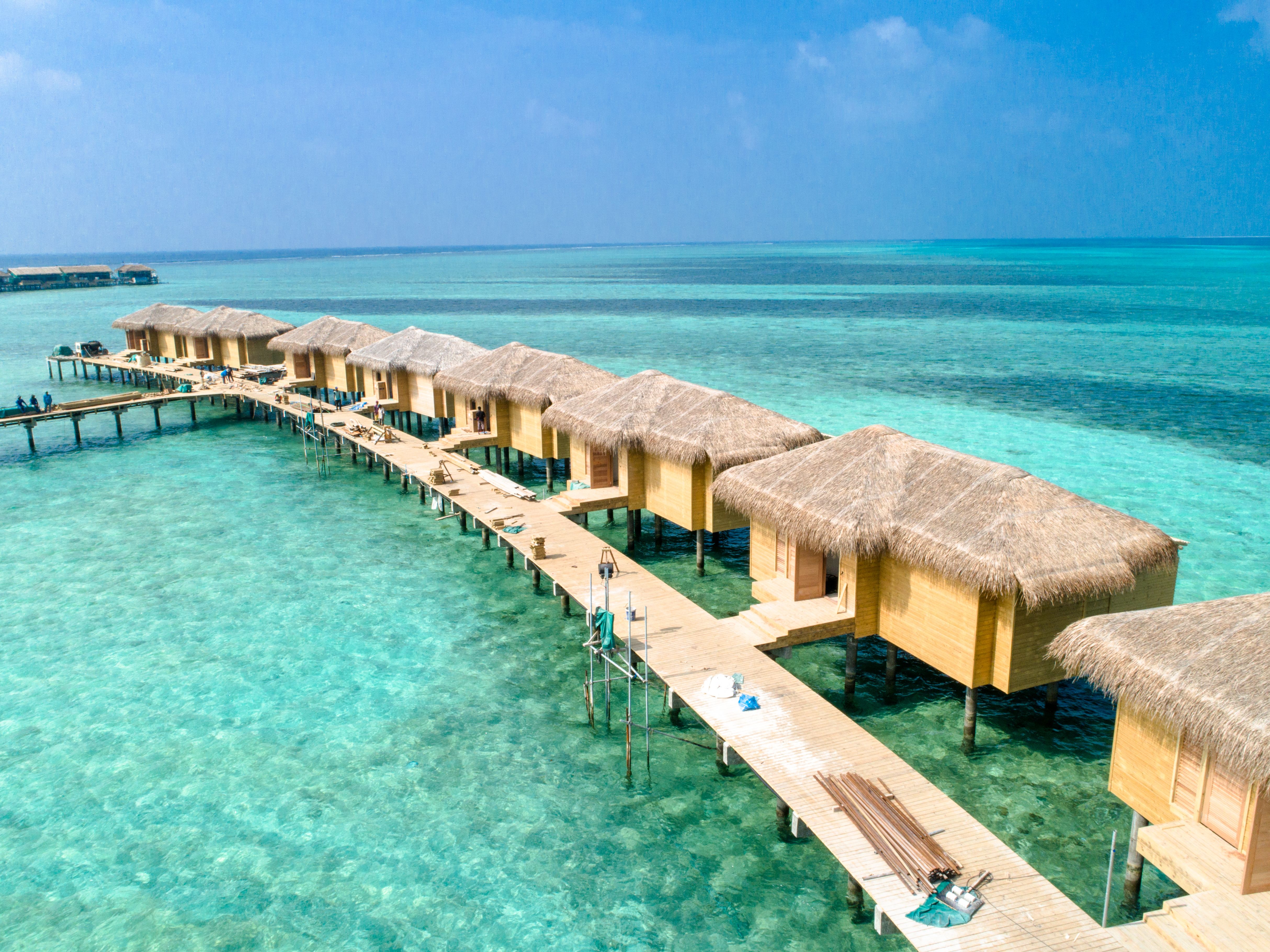
Search "Maldives travel package" and you'll get thousands of nearly identical listicles built around the same five stock photos of an overwater villa at sunset. None of them answer the question that actually matters before you hand over a deposit: what, specifically, am I paying for, and what's going to get added to the bill once I'm there?
This guide answers that directly — the kind of questions travellers actually ask right before they book, rather than a marketing brochure. By the end you'll know what a fair price looks like for your travel style, which costs are negotiable, and which ones aren't.
On this page
- Why the Maldives is sold as packages
- What's actually inside a package
- The three honest price tiers
- Speedboat vs seaplane transfers
- Best time to visit, by cost
- All-inclusive vs half-board vs room-only
- How many nights you actually need
- Tour operator vs booking it yourself
- A real sample cost breakdown
- Choosing your atoll
- Money & practical logistics
- Mistakes and hidden costs
- FAQ
Why the Maldives is almost always sold as a "package"
In most beach destinations, a package is a marketing convenience — you could just as easily book flights, a hotel and a taxi separately and come out roughly even. The Maldives is structurally different, and that's worth understanding before you start comparing prices.
The country is made up of roughly 1,200 coral islands grouped into atolls, and the vast majority of resorts each occupy their own private island. There's no road network connecting them. Getting from Velana International Airport (MLE), on the island next to the capital Malé, to your resort is itself a transport leg — by speedboat, domestic flight, or seaplane — and that leg is priced and booked through the resort, not through a taxi rank. That single fact is why "package" pricing dominates here: the transfer is non-optional, often expensive, and most travellers would rather have it bundled and pre-arranged than negotiated on arrival in a country where they don't speak the local language, Dhivehi.
So when you see "Maldives travel package," it almost always means: accommodation + airport transfer, bundled together, sometimes with meals, and occasionally with international flights. The variation between operators is mostly in which of those pieces are included and at what level of comfort — not in some fundamentally different service.
What's actually inside a typical package
Strip away the marketing language and a Maldives package is built from five components. Knowing them lets you compare two "packages" that look similar on price but are actually very different deals.
- The stay itself — nights at a guesthouse (local island) or resort (private island), in a specific room or villa category.
- The meal plan — ranging from room-only, to breakfast, to half-board, full-board, all-inclusive, or "all-inclusive premium" with branded spirits and à la carte dining.
- The transfer — speedboat, domestic flight + speedboat, or seaplane, each with a different price and travel time attached.
- Activities — sometimes a snorkelling trip or sunset cruise is bundled; more often these are sold separately once you arrive.
- International flights — bundled by some tour-operator packages, excluded by most resort-direct and OTA bookings.
Worth knowing
The single biggest price-comparison trap is comparing a package that includes the seaplane transfer against one that doesn't. A seaplane leg alone can cost ₹15,000–₹30,000 per person round-trip — enough to make a "cheaper" resort actually the more expensive total trip.
The three honest price tiers
Most comparison sites either show you the cheapest possible number (which is rarely the deal you'll actually get) or only the luxury end (because that's what generates clicks). Here's what the market genuinely looks like across the depth of the price range, for a couple travelling for 4 nights / 5 days in 2026, per person, in INR.
| Tier | Stay type | Meal plan | Typical cost (pp, 4N5D) | Transfer |
|---|---|---|---|---|
| Shallow (Budget) | Local-island guesthouse | Breakfast only | ₹40,000 – ₹55,000 | Public ferry / shared speedboat |
| Mid-depth (Popular) | 3–4★ resort island, garden/beach villa | All-inclusive | ₹95,000 – ₹1,40,000 | Speedboat (included) |
| Deep atoll (Luxury) | 5★ resort, overwater villa | Half-board to all-inclusive premium | ₹3,00,000 – ₹8,00,000+ | Seaplane (often included) |
None of these figures include international flights to Malé, which typically add ₹25,000–₹55,000 per person round-trip from major Indian or Pakistani cities depending on season and how far ahead you book.
The middle tier is where most first-time travellers end up, and for good reason: it's the first price point at which "all-inclusive" stops being a marketing word and starts being a genuine plan covering three meals, soft drinks, and usually a couple of snorkelling sessions or non-motorised water sports. Below that tier, "package" mostly just means "room plus a boat ride."
Speedboat vs seaplane: the transfer decision that changes your whole budget
This is the line item that breaks more travel budgets than any other, so it deserves its own section rather than a single bullet point.
Speedboat transfers serve resorts within roughly 40–50 minutes of the airport, mostly in North and South Malé Atoll. They're usually included in the room rate at mid-tier resorts, run on a fixed schedule a few times a day, and cost relatively little to operate — which is part of why resorts in this radius tend to sit in the mid-price tier overall.
Seaplanes reach resorts in further atolls — Baa, Raa, Noonu, parts of Ari Atoll — that a boat simply can't cover in reasonable time. Seaplanes only fly in daylight, which constrains your arrival and departure flight timing more than people expect, and they're priced as a near-fixed cost per route regardless of how full the plane is. That fixed cost is a major reason luxury resorts in remote atolls carry premium pricing: it isn't only the villa, it's the only realistic way to reach it.
Practical tip
If your international flight lands in Malé after dark, double-check your transfer method before booking. Seaplanes don't operate at night, which means a late arrival can mean an unplanned overnight stay in Malé or Hulhumalé before you even reach your resort — an extra cost most package comparisons don't mention.
Best time to visit, and what it does to the price
The Maldives sits close to the equator, so temperature barely shifts across the year — what changes is rainfall, swell, and demand, and all three move prices.
- November to April (dry season) — calmer seas, less rain, the most reliable diving and snorkelling visibility. This is also peak demand, so resort rates run 20–40% higher than the rest of the year, and Christmas/New Year carries its own premium on top of that.
- May to October (wet season) — short, heavy showers rather than all-day rain, and genuinely good value: many of the same resorts discount rooms, add free-night offers, or upgrade meal plans to fill rooms. Surfers specifically prefer this half of the year, since swell is stronger.
If your dates are flexible, shoulder months — May, June, September, October — tend to offer the best balance: still reliably warm and sunny most days, with pricing much closer to wet-season discounts than dry-season peaks.
All-inclusive vs half-board vs room-only — what the labels actually mean here
Meal-plan terminology gets used loosely across booking sites, and in the Maldives specifically the gap between tiers is larger than in most destinations, because there's no option to walk off the resort island for a cheaper dinner.
- Room only / breakfast only — common at guesthouses and budget resorts. Lunch and dinner are paid per meal, which adds up fast given the limited on-island options.
- Half-board — breakfast and dinner included, lunch separate. A common default at mid-tier resorts.
- Full-board — all three meals included, usually at set restaurants rather than full menu choice.
- All-inclusive — meals plus soft drinks and often local alcohol, sometimes a set number of activities.
- All-inclusive premium — adds branded/imported alcohol, à la carte dining across multiple restaurants, and sometimes spa or excursion credits.
Because there's nowhere else to eat, it's worth doing the maths on your own habits before assuming all-inclusive is automatically the better deal: a couple that drinks little and eats modest portions can sometimes come out ahead on half-board plus a handful of à la carte meals, while a family of four will almost always save more on all-inclusive.
How many nights do you actually need?
4 nights / 5 days is the package length you'll see most often for a reason — it's long enough to feel like a real holiday once transfer time is factored in, without pushing the budget into territory that only luxury travellers sustain.
| Duration | Best suited to | Why |
|---|---|---|
| 3N4D | Quick getaway, stopover trip | Workable, but one full day is effectively absorbed by arrival/transfer/departure logistics |
| 4N5D | First-time couples, short family trips | The sweet spot — a genuine 3–4 full beach days after transfers |
| 6N7D | Honeymoons, milestone trips | Comfortable pace, room to add a half-day excursion without feeling rushed |
| 8N+ | Two-island stays, dive trips | Worth splitting across a resort and a local island, or building in a liveaboard diving leg |
Tour operator package vs booking it yourself
Once you've decided on a budget tier, there's a second decision that matters just as much: do you book a pre-built package through a tour operator, or assemble the trip yourself across a flight site, a hotel-booking platform, and the resort's own transfer desk?
A packaged tour (the kind sold by large Indian travel agencies) bundles flights, resort stay, transfers and sometimes visa paperwork into a single price and a single point of contact — useful if this is your first international trip, if you're travelling as a larger family group, or if you simply don't want another browser tab open while you plan. The trade-off is reduced flexibility on room category and dates, and a markup that's harder to see since everything is bundled into one number.
Booking it yourself — flights through a comparison site, the resort stay through a platform like Agoda or directly with the resort, transfer arranged with the resort once your room is confirmed — generally costs 10–20% less for the same room category, because you're not paying a bundling margin. It does require comparing three or four things separately rather than one, and you're responsible for making sure your flight times actually line up with transfer availability (seaplane cut-off times in particular).
There's no universally "right" answer here — it genuinely depends on how much you value having someone else hold the pieces together versus how much you value the savings and control of doing it yourself.
A real sample cost breakdown
To make this concrete: here's an itemised mid-tier budget for two people, 4 nights / 5 days, travelling in the value-friendly shoulder season, booking everything separately.
| Item | Cost (for 2 people) |
|---|---|
| Round-trip flights to Malé (from a major Indian/Pakistani city) | ₹70,000 – ₹1,00,000 |
| 4 nights, mid-tier resort, all-inclusive, beach villa | ₹1,90,000 – ₹2,40,000 |
| Speedboat transfer, round-trip | Included / ₹8,000 |
| One snorkelling excursion | ₹6,000 – ₹9,000 |
| Visa on arrival | Free (30 days, most nationalities) |
| Approximate total, for two | ₹2,70,000 – ₹3,55,000 |
That works out to roughly ₹1.35L–₹1.78L per person all-in — comfortably inside the mid-depth tier once flights are added, which is a useful sanity check whenever a "deal" price looks too good: ask whether flights, the transfer, and the meal plan are actually all in the number you're looking at.
Choosing your atoll: Malé, Ari, or further out
Price tier and atoll location are tied together more tightly than most comparison sites let on, so it's worth understanding the geography before you fall in love with a specific resort's photos.
- North & South Malé Atoll — the closest cluster to the airport, reachable by speedboat in 20–45 minutes. This is where most mid-tier, speedboat-transfer resorts sit, and it's also where most of the budget guesthouse islands (Maafushi, Guraidhoo, Hulhumalé) are found. Good for short trips and first-timers who don't want a long transfer eating into a short holiday.
- Ari Atoll — roughly 25–35 minutes by seaplane or 1.5–2.5 hours by speedboat, depending on the specific resort. Known for some of the best snorkelling directly off the house reef, and a sweet spot a lot of repeat visitors choose: closer than the far atolls, but with noticeably clearer water and fewer day-trippers than Malé Atoll.
- Outer atolls — Baa, Raa, Noonu, Lhaviyani, and further south — almost always seaplane-only, 35–50 minutes flight time. This is where most of the flagship luxury resorts are, partly because the remoteness itself is the product. Expect the transfer cost to be baked into an already-premium room rate.
A practical rule of thumb: if your trip is 4 nights or fewer, a North or South Malé Atoll resort gets you more actual beach time, since you're not losing half a day each way to a seaplane connection. If you're staying 6 nights or longer, the extra transfer time becomes a much smaller fraction of the trip, and an outer-atoll resort starts making more sense.
Money, payments and a few practical logistics
A handful of practical details consistently surprise first-time visitors, and they're worth sorting out before you fly rather than discovering them at check-in.
The local currency is the Maldivian Rufiyaa (MVR), but resorts and tourist-facing businesses quote and settle almost everything in US dollars, and most accept Visa and Mastercard without issue. Carrying a small amount of cash is still sensible for tips and for the local-island guesthouses and cafés that aren't card-only. UPI payments have also become workable at a growing number of resorts and Malé shops, which is useful to know if you'd rather not carry much foreign currency at all.
Wi-Fi is near-universal at resorts now, though speed varies a lot by how remote the island is — outer-atoll luxury resorts sometimes throttle bandwidth deliberately as part of the "digital detox" positioning, so check this in advance if you need to stay reachable for work. A local SIM or an eSIM purchased before departure is worth it if your resort's wi-fi turns out patchy, since there's no fallback once you're on a private island.
Pack reef-safe sunscreen specifically — several resorts and marine protected areas now restrict regular sunscreen because of coral bleaching concerns, and it's far easier to buy the reef-safe version at home than to find it on a small island. Beyond that, the packing list is simple: light, modest swimwear is fine at resorts but worth dressing slightly more conservatively in Malé itself and on inhabited local islands, which follow standard Maldivian social norms outside the resort bubble.
Mistakes and hidden costs that catch first-timers
Most of the budgets that blow past expectations don't fail because of one big mistake — they fail because of three or four small ones that each quietly add a few thousand rupees. These are the ones we see most often.
- Comparing room-only rates against all-inclusive rates as if they're the same product. A villa that looks ₹15,000 cheaper per night might simply be excluding meals you'd pay for anyway at a destination with no outside dining options — always normalise to the same meal plan before comparing two resorts.
- Ignoring the resort service charge and GST, commonly an extra 10–12% added at checkout, which some listing prices quote before tax and some after. On a luxury booking this alone can run into tens of thousands of rupees, so always check whether the headline price is the final price.
- Booking a seaplane resort with a late-arriving flight, then discovering seaplanes don't fly after dark. This is one of the most common — and most avoidable — planning errors, and it can force an unplanned, self-funded overnight in Malé before the holiday has even started.
- Underestimating activity costs at luxury resorts, where a single guided dive or sunset cruise can run ₹8,000–₹15,000 per person. If excursions are a big part of why you're going, check whether your meal plan or villa category already bundles a few, since some do.
- Forgetting the resort-island reality — once you've checked in, you generally cannot leave for a cheaper meal elsewhere, so a few expensive evenings are simply part of the deal at every tier above guesthouse-level. Budgeting for this upfront avoids the holiday-souring sticker shock at the in-room dining menu.
- Not checking the cancellation policy on the package rate specifically — promotional all-inclusive rates are very often non-refundable, while flexible rates cost noticeably more upfront. Given how far ahead most Maldives trips get booked, it's worth choosing that trade-off deliberately rather than discovering it later, after a date change becomes necessary.
Frequently asked questions
How much does a Maldives travel package cost?
For 2026, budget guesthouse packages start around ₹45,000 per person for 4 nights, mid-range all-inclusive resort packages run roughly ₹95,000 to ₹1.4 lakh per person, and luxury overwater villa packages start from about ₹3 lakh per person — before international flights in most direct-booking cases.
Does a Maldives package include flights?
Sometimes. Packages booked through a tour operator often bundle international flights, while packages booked directly with a resort or through a hotel-booking platform like Agoda usually cover only the resort stay and local transfer, leaving you to book flights separately.
How many days are enough for a Maldives trip?
4 nights and 5 days is the most common and best-value length for a first Maldives trip. 3 nights feels rushed once arrival and transfer time are accounted for, while 6 or more nights suits honeymoons or a stay split across two islands.
Is the Maldives all-inclusive, or do you pay extra for everything?
Both exist. Budget guesthouses are usually breakfast-only, mid-range resorts increasingly offer genuine all-inclusive plans, and luxury resorts often default to half-board or full-board, with alcohol, excursions and spa treatments priced as extras unless you specifically book an all-inclusive-premium plan.
Do Indian and Pakistani travellers need a visa for the Maldives?
No advance visa is required. The Maldives issues a free 30-day visa on arrival to most nationalities, including India and Pakistan, provided you can show a confirmed onward ticket and proof of accommodation for your full stay.
Is it cheaper to book a Maldives package or arrange everything separately?
Booking flights, the resort stay and the transfer separately is usually 10–20% cheaper than a bundled tour-operator package for the same room category, because you avoid the bundling margin. A packaged tour is worth the premium mainly when you want a single point of contact handling everything, including visa paperwork and date changes.
Where to go from here
If you've settled on a tier from the table above, the next practical step is comparing live resort rates rather than list prices, since Maldives pricing moves with occupancy more than almost any other destination we cover. If you'd like every cost on this page broken down further — by traveller type, by season, and with three fully worked example budgets — see our full Maldives trip cost breakdown.
Some links above are affiliate links. If you book through them, we may earn a small commission at no extra cost to you. We only link to platforms we've verified list genuine Maldives inventory.